
Why Nature Matters More Than Ever for Today’s Teens
It’s a familiar scene. You’re talking to a young person, but their attention is somewhere else, split between you, their phone, and whatever comes next on the screen. A conversation competes with notifications. A moment competes with a scroll.
It’s easy to label this as distraction or disinterest. But the reality is far more complex. This is the environment young people are growing up in. Almost every environment involves a device and screen dependency is the norm.
So the question becomes: what happens when that digital noise disappears?
The World Young People Are Growing Up In
Today’s teenagers are navigating a world of constant stimulation. Short-form videos, endless feeds, notifications, and algorithms designed to capture attention have made distraction the default. Even in school students are often provided laptops or ipads. Focus is no longer a given, it’s something that must be actively reclaimed.
At the same time, something else has quietly declined. Time spent outdoors. Research suggests that young people today spend significantly less time outdoors than previous generations, with some studies showing children now spend as little as 1 hour outdoors a day.
Attempts to regulate this environment—such as social media age restrictions—highlight growing concern. Yet early reports suggest many young people continue to access these platforms regardless. Some studies show up to 60% of under 16’s still have access to restricted social media platforms. Restriction alone is not solving the problem. Because the issue isn’t just access. It’s what has been replaced.
What Screens Are Replacing
When screen time increases, something else inevitably decreases.
- Unstructured time
- Face-to-face interaction
- Moments of boredom
- Time in nature
And while boredom is often seen as something to avoid, it plays a critical role in development. It creates space for creativity, reflection, and problem-solving. Nature does something similar. It offers stillness, space, a break from constant input.
When these experiences disappear, young people don’t just lose time outdoors—they lose opportunities to think, process, and connect. It’s not just what screens provide. It’s what they displace.
Nature as a Reset
This is where nature plays a powerful role. The Attention Restoration Theory, developed by Kaplan and Kaplan, suggests that natural environments help restore depleted cognitive resources. Unlike screens, which demand attention, nature allows the brain to recover from it.
Time spent outdoors has been linked to:
- Improved focus and concentration
- Reduced mental fatigue
- Lower stress levels (including reduced cortisol)
- Improved emotional regulation
Nature doesn’t overwhelm the senses, it gently engages them. In a world of constant stimulation, that’s exactly what young people need.
The Power of Being Unplugged
One of the most consistent patterns we see at AdventureWorks WA happens in the first 24 hours of a program.
Phones are not allowed on camp, and at first, there can be resistance. Restlessness. A sense of disconnection. But then something shifts.
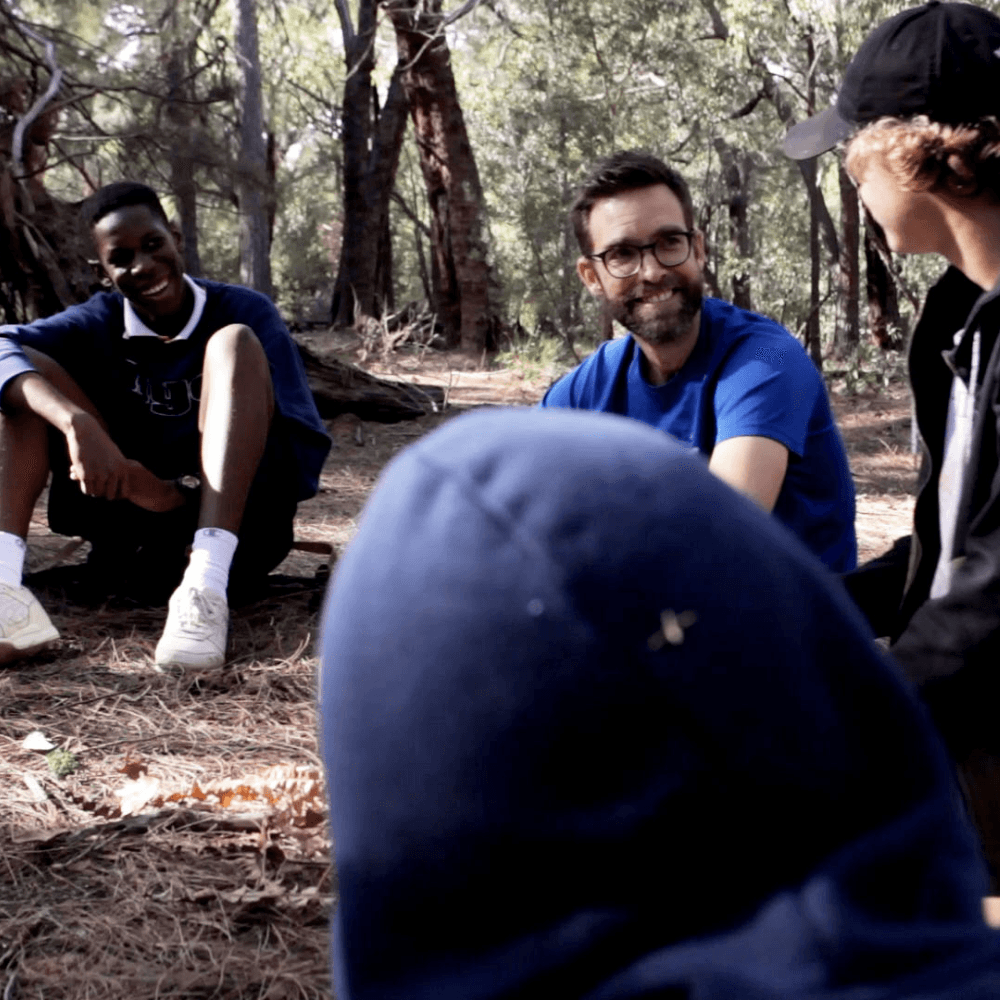
Conversations become deeper. Attention becomes present. Laughter becomes easier, and students begin to engage not just with the activities, but with each other at a far greater level.
In fact, 65% of students in our programs say that being off their phone was the highlight of their camp experience.
We hear it again and again in student reflections:
“I didn’t realise how much I needed a break.”
“It was actually nice not being on my phone.”
This challenges a common assumption. It’s not that young people can’t go without their phones. It’s that they’re rarely given the opportunity to. And when that opportunity is created, they don’t just cope. They thrive.
Identity and Space to Think
Perhaps the most powerful shift that happens away from screens is less visible.
Without constant input, young people are left with something unfamiliar: Space.
And in that space, important questions begin to emerge:
- Who am I?
- What do I care about?
- How do I show up in the world?
These are not questions that can be answered while scrolling. They require stillness. Reflection. Time.
Research into adolescent development highlights that identity formation relies on opportunities for reflection and self-exploration. Without space to think, that process becomes significantly harder.
You can’t hear your own thoughts in constant noise.
Why Restriction Alone Doesn’t Work
It’s tempting to view this challenge through a simple lens: reduce screen time, solve the problem. But it’s not that straightforward. Young people are adaptable. Remove one platform, and another appears. Set limits, and they usually find ways around them.
Because the issue isn’t just access. It’s dependence on what screens provide:
- Stimulation
- Connection
- Escape
If we want meaningful change, we can’t just remove screens. We need to replace what they offer with something better.
- Stimulation → challenge
- Escape → purpose
- Connection → belonging
Why Nature Matters More Than Ever
Nature offers something uniquely powerful in today’s world—and the evidence is becoming impossible to ignore.
Research shows that regular time in natural environments can significantly improve young people’s cognitive, emotional, and social wellbeing. Studies have found that exposure to green spaces is linked to improved attention, reduced mental fatigue, and stronger academic performance.
Spending time outdoors has also been shown to lower stress levels. One study found that as little as 20 minutes in nature can significantly reduce cortisol, the body’s primary stress hormone.
Beyond the cognitive and emotional benefits, nature also plays a critical role in social development. Outdoor experiences encourage cooperation, communication, and shared problem-solving—skills that are far harder to develop through screens alone.
In contrast, increased screen time has been associated with reduced attention spans, increased anxiety, and lower overall wellbeing in adolescents. At the same time, young people are spending less time outdoors than ever before, missing out on experiences that are essential for healthy development.
This is where nature becomes more than just a “nice to have.”
It provides:
- Stillness without boredom — space for reflection and clarity
- Challenge without overwhelm — opportunities to build resilience
- Connection without comparison — real relationships, free from social pressure
- Presence without distraction — the ability to fully engage in the moment
As time outdoors continues to decline, its value only increases. In a highly digital world, these experiences are no longer optional extras.
They are essential.
Reclaiming Balance
At AdventureWorks WA, our approach is not about eliminating technology. It’s about restoring balance. Through immersive outdoor experiences, we create environments where young people can step away from the noise and reconnect with themselves, with others, and with the world around them.
When we give young people space away from screens and back into nature, we’re not taking something away, we’re giving something back.
Sources:
https://anzmh.asn.au/blog/mental-health/great-outdoors-boost-your-mental-health
https://www.sciencedirect.com/science/article/abs/pii/0272494495900012
https://www.frontiersin.org/news/2019/04/09/20-minute-nature-pill-relieves-stress